Anatomy
- Diastasis recti Anatomy
- Separation of the rectus abdominis muscles along the linea alba (the connective tissue that runs vertically down the midline of the abdomen). Common after pregnancy, affecting up to 30% of women at one year postpartum. Surgical repair (plication) is the only definitive correction once the gap exceeds approximately 2 cm.
- Linea alba Anatomy
- The fibrous band of connective tissue running from the sternum to the pubic bone, joining the left and right rectus abdominis muscles. Stretching or thinning of this tissue is what produces visible abdominal bulging in diastasis.
- Rectus abdominis Anatomy
- The paired vertical muscles of the abdomen, commonly called the 'six-pack' muscles. In a tummy tuck with diastasis repair, these are surgically brought back to the midline and held with internal sutures.
- Subcutaneous fat Anatomy
- Fat that lies between the skin and the muscle layer. This is the fat targeted by liposuction. Visceral fat (around organs) cannot be removed by liposuction or tummy tuck — only by weight loss.
- Pectoral muscle Anatomy
- The chest muscle behind the breast tissue. The 'subfascial' breast augmentation plane sits between the breast tissue and the fascia overlying this muscle, avoiding muscle disruption.
Procedure
- Abdominoplasty Procedure
- Medical name for a tummy tuck. Removes excess skin and fat from the lower abdomen and tightens the abdominal muscles. A 'full' abdominoplasty includes repositioning of the umbilicus (belly button).
- Mastopexy Procedure
- Medical name for a breast lift. Repositions the nipple-areola complex higher on the chest wall and reshapes the breast tissue. Performed alone, with implants (augmentation-mastopexy), or with reduction.
- Augmentation-mastopexy Procedure
- Combined breast lift with implant placement in one operation. More complex than either procedure alone — the surgeon must reshape and reposition the breast while accommodating an implant.
- Liposuction Procedure
- Removal of subcutaneous fat using thin cannulas through small incisions. Reshapes contour rather than producing weight loss.
- 360° liposuction Procedure
- Liposuction performed circumferentially around the torso — abdomen, flanks ('love handles'), and lower back — for complete waist contouring. Often combined with tummy tuck in a mommy makeover.
- Plication Procedure
- The technique of suturing two sides of stretched fascia together to close a gap. Used to repair diastasis recti during a tummy tuck. The result is a narrower, tighter waistline that exercise alone cannot produce.
- VASER liposuction Procedure
- Ultrasound-assisted liposuction. Uses ultrasonic energy to liquefy fat before suction, often producing a smoother result and better skin retraction. Particularly useful in fibrous areas or for high-definition contouring.
Implants
- Subfascial placement Implants
- Placing the breast implant beneath the fascia (a thin layer of connective tissue covering the pectoral muscle) but above the muscle itself. Combines benefits of submuscular and subglandular placement.
- Submuscular placement Implants
- Implant placed under the pectoral muscle. Offers more natural-looking upper pole in thin patients, but produces 'animation deformity' (implant moves with muscle contraction).
- Profile (implant) Implants
- How forward an implant projects relative to its base width. Profiles range from low (flat) to extra-high (very projecting). Choice depends on chest dimensions and aesthetic goal.
- Cohesive gel implant Implants
- Modern silicone breast implants in which the silicone gel is cross-linked into a soft solid that holds its shape — sometimes called 'gummy bear' implants. Reduces leakage risk.
Recovery
- Drain (surgical drain) Recovery
- A thin tube placed during surgery that allows fluid to leave the surgical site. Typically removed at 5–7 days for tummy tuck. Helps prevent seroma.
- Compression garment Recovery
- A medical-grade elastic garment worn after surgery to support tissues, reduce swelling, and shape healing tissue. Typically worn 4–6 weeks for tummy tuck, day and night for the first 2–3 weeks.
- Lymphatic massage Recovery
- Gentle, specific massage technique that encourages drainage of postoperative oedema. Improves comfort and may speed swelling resolution. Begun around days 5–10 post-op.
- Scar maturation Recovery
- The 12–18 month process during which a surgical scar progressively softens, flattens, and lightens. Most scars look worse before they look better — peak redness is around 2–3 months.
Complication
- Seroma Complication
- A fluid collection beneath the skin or in the surgical pocket — most common complication of tummy tuck. Usually resolves with needle aspiration; rarely requires further surgery.
- Hematoma Complication
- A collection of blood within tissue, often from a small bleeding vessel after surgery. May require return to operating room if large; small ones reabsorb on their own.
- Capsular contracture Complication
- Tightening or hardening of the scar tissue that naturally forms around any breast implant, sometimes distorting the implant shape. Modern techniques and antibacterial irrigation have reduced its incidence.
- DVT (deep vein thrombosis) Complication
- Blood clot in a deep vein, typically in the leg. A serious risk in any major surgery, prevented through compression stockings, blood-thinning medication when indicated, and early walking.
- Skin necrosis Complication
- Loss of blood supply to skin, causing tissue death. Rare in mommy makeover but highest risk at the lower abdominal flap edges. Smoking is the strongest risk factor; cessation 4 weeks pre- and post-op is essential.
Safety
- JCI accreditation Safety
- Joint Commission International — the global gold standard for hospital quality and patient safety. JCI-accredited hospitals meet rigorous patient-care, infection-control, and safety requirements verified by periodic audit.
- FACS Safety
- Fellow of the American College of Surgeons. A peer-reviewed credential awarded to surgeons who demonstrate professional competence and ethical standing as judged by ACS. Held by Dr. Erdal since 2025.
- FEBOPRAS Safety
- Fellow of the European Board of Plastic, Reconstructive and Aesthetic Surgery. The pan-European board certification for plastic surgery, requiring written and oral examination. Held by Dr. Erdal since 2020.
- Doçent (Associate Professor) Safety
- Turkish academic rank requiring doctoral-level scholarly contribution and successful examination. Indicates that the surgeon is recognised by the national academic system as having teaching authority and a research record.
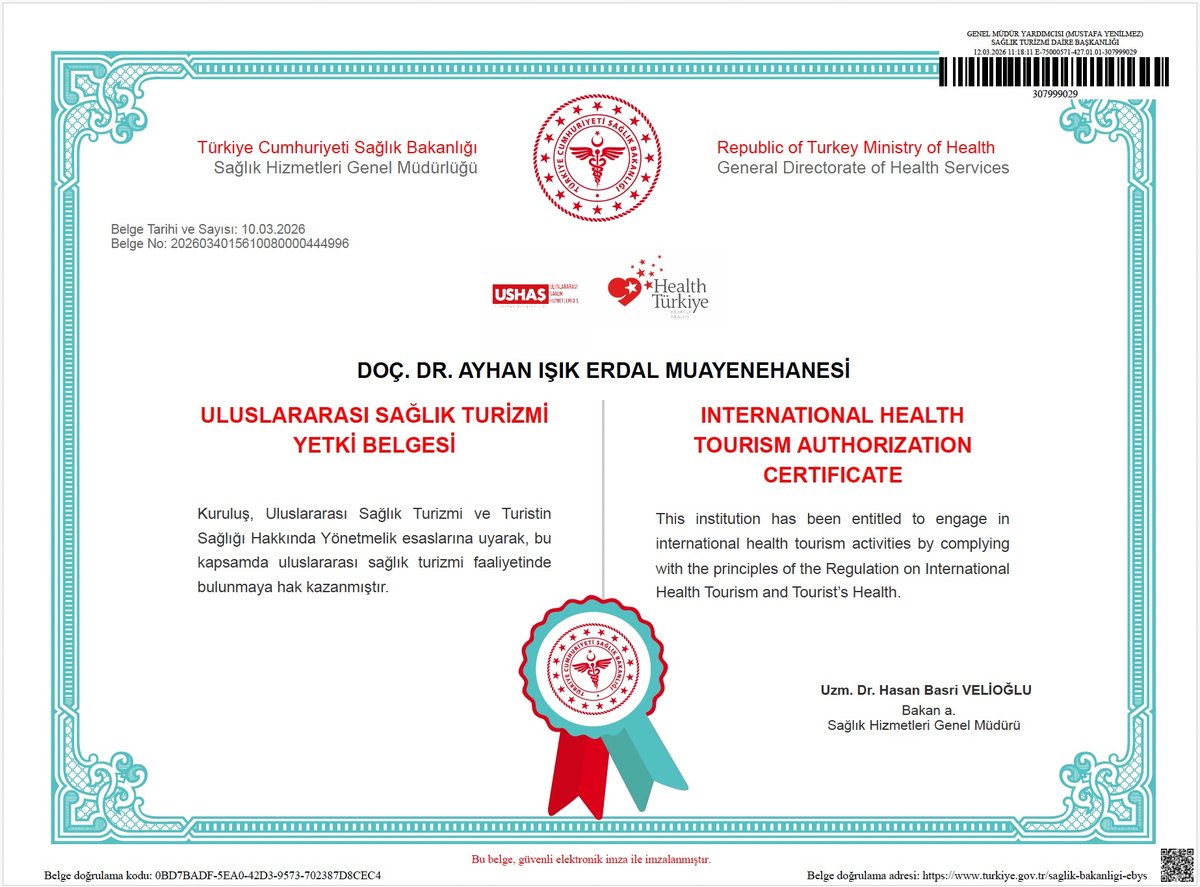
- Required certification from the Republic of Turkey Ministry of Health for clinics treating international patients. The MoH audits the clinic, surgeon credentials, and facility standards. Authorization No: 2026034015610080000444996.
- Anaesthesiologist (board-certified) Safety
- A physician trained specifically in anaesthesia. In modern combined plastic surgery, the anaesthesiologist is often the second most important professional after the surgeon. Always check that they are present and board-certified.
Still confused?
If you encounter a term that isn't on this page, the fastest answer is a free WhatsApp message to Dr. Erdal's clinic. The clinic coordinator (an English speaker) can usually translate the term — and often it's something with a simpler explanation than the medical literature suggests.